

October 2026
TL;DR
The power equipment supply chain crisis is not simply a factory shortage - it is a coordination failure between network operators, developers, EPCs and manufacturers. As a result, most projects are already behind schedule without knowing it.
European manufacturing capacity is approaching its limits, and manufacturers burned by the last cycle can’t expand until demand looks certain, while qualified capacity elsewhere is hard for buyers to find and verify. Until drawings are approved, a buyer can’t know the equipment lead time and therefore can’t know when the site can be energised, which is why the date is set in the factory, not the queue.
Scaling up the critical power equipment supply chain from a cottage industry to a global market is essential for industry growth beyond bilateral arrangements. This transition will reduce equipment lead times and accelerate energisation.
This is a cottage industry running critical national infrastructure.
The critical power equipment supply chain was built for exactly one buyer: the regulated utility or network operator, buying on multi-decade frameworks, in standard voltage classes, with regulator-approved, recoverable revenue behind it. Suppliers, or Original Equipment Manufacturers (OEMs), worked for decades with the same type of demand. Utilities and networks have created a structured power equipment procurement process that runs in multi-year cycles, giving them certainty to bet against. With this steady demand, OEMs grew their businesses, expertise, and relationships, and those relationships were built one-to-one: a buyer knows someone at the factory, they talk it through, and they shake on it. That worked well for decades of steady, predictable demand. It doesn’t scale to many new buyers arriving at once.
Today OEMs are being asked to serve data centre operators, renewables developers, independent network operators and industrials, all at once, at a scale nobody planned for. Those buyers don’t look like a utility, and they don’t buy like one.
Until 2020, incumbents held detailed electricity generation data. Ember started publishing it openly. The mechanism is shared: when a few incumbents hold information that buyers can’t see or compare, the market stays bilateral and slow. Dr Pawel Czyzak puts the effect plainly: “Historically, such data was available only to incumbents, who dictated not only prices, but also policy and politics. Thanks to increased transparency, competition in electricity balancing is improving.” He adds: “The same needs to happen in the equipment layer.”[6]
The buyers journey.
Stage one: application to connection offer. This is documented and the faster part. Great Britain publishes three months to a transmission offer once the application is deemed complete, and 65 working days for a distribution connection needing higher-voltage works. Both are regulated maximums, not averages. The time before the clock starts isn’t published anywhere.[16] Ireland publishes 7.5 months where the nominated generation already holds an offer, and up to 18 months where generation is applied for in parallel.[17] Spain publishes six months from the announcement of a demand competition to the results.[18]
Followed by pre-emptive design. At this stage, the design team can make educated guesses on what they will need, and the procurement team can start looking for quotes. However, designs can’t be finalised, and a Bill of Materials (BoM) can’t be determined until a connection date is given. This isn’t a published milestone in any market.
Stage two: offer to energisation, which includes details on exactly what a buyer needs to procure, and by when. Nobody publishes this. Anywhere. No operator or regulator in the UK, Europe, or the United States publishes how long it takes to go from an agreed connection to an energised site. Every “total” figure in circulation is a network build time, a consultancy estimate, or an operator’s testimony.
Lawrence Berkeley National Laboratory said so in print in June 2026: “Most transmission owners, transmission providers, and distribution utilities do not publish data on load interconnection queues,” and “there is limited publicly available information on large load interconnection timelines or costs.”[19]
Dominion Energy Virginia told customers in 2024 that connections above 100 MW in its zone would take four to seven years, up from three to four. [20] Data centre operators in France describe three to seven years, up from two to three, which is described as testimony rather than a measured average.[21]
A project requiring energisation can tell you the day when their connection offer is due. No published source anywhere tells them when they’ll be switched on.
Then Final Investment Decision (FID). Money is committed, and the project becomes real. With a confirmed offer of connection and financing, the BoM and designs can be finalised to the exact power and engineering specifications. This is when the procurement team reaches out to OEMs to confirm their drawings, which dictate their slot in the OEM’s production queue.
Between a confirmed connection date and the point an order must go in, procurement teams have a short window. Vetting a new factory means audits, site visits and accreditation checks, and few teams have the time or budget to do that for a manufacturer they don't already know.[24] So buyers go to the incumbents they trust or the people they know personally, which is a sensible choice under a deadline. Demand then concentrates on the same few factories while qualified capacity elsewhere goes unconsidered.
The OEM's journey.
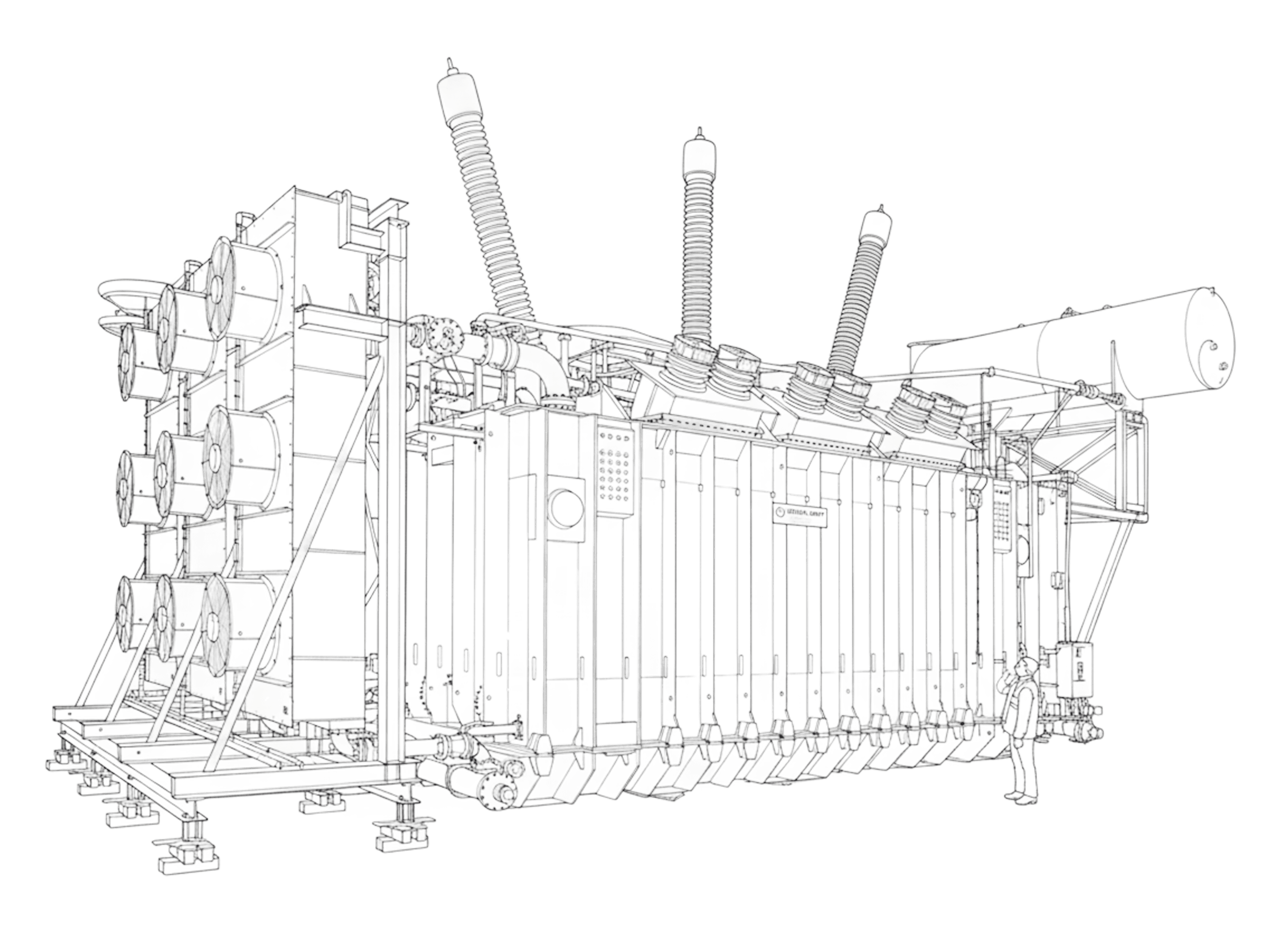
What’s being made. A large power transformer is built to order for one location, from a drawing that must be approved before anything is cut. High-voltage power transformers are the size of a shipping container and can weigh up to 400 tonnes. Its core is a specialist steel, stacked by hand in sheets thinner than a credit card. At Delta Star in Lynchburg, Virginia, it takes five to seven years to train someone well enough to wind the coils.[22]
The clock starts not when you enquire, or order, but when the drawings are approved. We asked a panel of twenty manufacturers about two identical reference specifications. Three quote their lead times explicitly from drawing approval, and one states that drawing approval is the only stage that can realistically be accelerated.[4] The months you think you’re buying by ordering early aren’t there until the design is finalised.
Payment terms. Building a bespoke transformer commits the manufacturer’s materials, labour and factory slot to a single order, so these terms protect them against stranded capacity. Across every manufacturer in our panel that disclosed terms, 90 to 100% of contract value falls due pre-delivery, and four of the eight require 100% before shipment.[4] A published supply agreement shows the shape: 30% on order, 20% on drawing approval, reaching 90% before the unit ships.[23]
Once building starts, you can’t amend anything. Once manufacturing is underway, cancelling costs 80 to 100% of what you’ve committed, because the manufacturer has already tied up materials, labour and a factory slot that can’t easily be reassigned. Once core and coil assembly begins, it costs everything. One manufacturer in our panel doesn’t permit cancellation at all.[4] No one sells a position you can hand off to a different project.
And the warranty is already running. Warranties typically run three to five years from delivery date rather than from installation, and storage periods of twelve months and beyond are common.[24] A buyer who takes delivery early to protect a slot burns warranty doing it.
One finding surprised us. Our questionnaire offered grain-oriented electrical steel as an example of a supply constraint. Not one supplier named it. Not one named copper. Every constraint named was either a bought-out sub-component or a specification choice: bushings, on-load tap changers, gauges, logistics.[4]
The constraints suppliers named point to the buyer’s own bill of materials as a likely driver of lead time.
Where the industry stands.
Demand changed shape.
Electricity demand in advanced economies was flat for roughly fifteen years, with brief spikes during Covid and the 2022 energy crisis.[1] Four things then arrived together: energy security, electrification, decarbonisation, and AI compute. The grid they arrived at is also overdue for renewal.
Europe’s installed base of 4.5 million transformers has to nearly double to 9 million by 2050.[5] Global grid procurement already runs at around $400 billion a year.[7] The demand is real, funded, and durable.
The queues show it.
These are the demand queues. Data centres connect as load. The huge queue numbers you’ll see quoted - Britain’s 700 GW, America’s 2,061 GW, Berkeley Lab’s 61-month median - are generation and storage. Different queue, different process, different clock.
In Great Britain, contracted demand went from 41 GW to 125 GW between November 2024 and June 2025. Around 73 GW of that is data centres, across roughly 315 projects ranging from 1 MW to over 1,500 MW. GB peak demand in 2025/26 was 45 GW. Between May 2024 and August 2025, at least 9 GW switched their connection request from battery to data centre.[8]
In Italy, Terna is barred from pre-filtering requests, so 95.38 GW across 531 requests has piled up since 2021. Of that, 1.88 GW has reached the most advanced stage. Eight data centres are actually connected.[9]
In Virginia, USA, Dominion is holding roughly 70 GW of large load requests against an all-time system peak of 24.7 GW.[10]
In the Netherlands, 15,014 businesses and 9,305 MW were in the distribution demand queue at the end of 2025. In congested areas, requests go on a waiting list until capacity becomes available. There’s no date.[11]
In Spain, around 75% of transmission nodes show no available capacity for new demand.[12]
The equipment industry didn’t move with demand.
High-voltage power transformer lead times nearly doubled to about 46 months across 2023 and 2024. A 2025 industry survey found securing one can take up to four years.[2] In Q2 2025, power transformers were at 128 weeks and generator step-up units at 144 weeks, compared to a pre-pandemic norm of 50 to 60 weeks.
Demand is up 119% for power transformers, 274% for generator step-ups, and 116% for substation units since 2019. Unit prices are up 77% and 45%, respectively.
Medium-voltage switchgear is up roughly half since 2019.
Distribution transformers shipped in six weeks before the crunch, peaked above 100 weeks in 2023, and still run to around 30 weeks, because they are smaller and simpler to build, and parts are more readily available.[3]
Inputs are up too. Grain-oriented electrical steel, the magnetic core of every transformer, is up 60 to 100% since 2020.[13]
Why didn’t the supply chain respond quickly to new demand?
They tried that once, and it cost them dearly. The 2008 crisis left many OEMs holding stranded capacity through the 2010s after heavily investing ahead of an electrification upswing that didn’t arrive. ABB sold its Power Grids business to Hitachi for $11 billion: announced in December 2018, 80.1% closed in July 2020, and the remaining stake was sold in Q4 2022.[14] Caution was learned here, and it was learned expensively.
The large OEMs are investing now. Siemens Energy closed FY2025 on a record €138 billion backlog, with grid technologies and data centres named as primary drivers.[15] New capacity is coming, but it will be sold on the same terms, through the same channels, to the same priority buyers, unless something else changes.
Why are demand and supply out of sync?
The buyer needs certainty, flexibility and reliability. The OEM needs certainty in the order book to plan capacity, train talent, and underwrite new plants. The buyer’s need for flexibility creates the manufacturer’s uncertainty.
Nobody runs the relay: network operator, developer, EPC, manufacturer. Energising a site on a fixed date requires all four to hand off cleanly. Instead, each runner is on a different track, running a different race. The connection baton arrives late, financing arrives after the deposit is due, and the EPC carries risk before the previous runner has reached them. Nobody owns the sequence as a whole.
The money arrives after it’s needed. Financial close requires equipment commitments, which require deposits. Deposits require capital only available at financial close. The window to place an equipment order is precisely when developers have the least capital. It gets worse as buyers move toward operating-expenditure models because manufacturers are built to sell assets, not flexibility.
New demand can’t be underwritten the old way. Utility frameworks are the underwriting standard. New demand arrives in non-standard configurations, in smaller batches, below utility-grade credit. If your credit profile, order volume, or specification doesn’t clear that bar, the new capacity isn’t for you.
Verification doesn’t travel. Capable manufacturers in Asia and Central Europe can be cheaper and faster but still can’t reach the market because every engineering team redoes the same factory assessment and network operators default to approved equipment registers. CIGRE has published a standard framework for assessing a transformer manufacturer’s capability since 2013.[25] Thirteen years on, evidence still doesn’t move between buyers. Qualified supply exists, but the market has no way to find it.
The reality check.
Most of the above is structural, which makes it easy to nod at and hard to prove. There’s one place the gap has been written down, dated and made checkable, and it happened this summer.
On 29 July 2026, Ofgem proposed that a data centre developer in Great Britain must show evidence of a committed order for long-lead electrical equipment to keep its place in the connection queue, with the proof falling due at a fixed point before the connection date. For a project connecting in four years, the proof is due two years out. No published source defines lead time, so the roughly four-year market figure means different things to different manufacturers. Our working assumption is that it runs from drawing approval, because nothing can be built until drawings are approved and nothing is standardised. On that assumption, the design must be fixed before the clock starts, so the order was needed more than four years out.[26][2]
The date you must prove you ordered arrives after the date you needed to order.
That’s a proposal, not a decision; we are waiting on the results of that consultation process. Our response is published. The arithmetic doesn’t depend on the outcome.
What is market infrastructure?
Market infrastructure is the coordination layer that underpins an industry and allows it to grow. It makes no steel and builds no factories, but it does let demand and supply find each other with ease. Market infrastructure provides the intelligence that enables manufacturer discovery, quality comparability, and liquidity. Building an intelligent market infrastructure layer de-risks trade and improves efficiency.
Is market infrastructure hard to build? Yes.
Mark Ducommun, a power equipment expert and director at PSP Limited, describes it precisely: “Although European transformer manufacturing capacity is approaching its limits, supply constraints are not confined to factory output. Utilities and network operators face shortages of experienced engineering resources, which can delay the assessment and approval of alternative transformer suppliers.”[28]
European factory output and assessment capacity are both near their limits, which is why qualified supply from outside Europe matters.
There’s also a reason no existing party will build this layer. OEMs can’t because they must be neutral across competing manufacturers. Lenders can’t because they price single transactions, not structural mismatch. EPCs, developers, and connection providers can’t because each sits on one side of the market.
How is this different from brokerage? A broker is paid on a transaction and holds no position. Market infrastructure takes a different shape, which later chapters will cover.
Why us? Because we solved the discovery problem once at small scale. Twenty manufacturers, one standardised questionnaire, two identical reference specifications, comparable answers. The answers showed how little of this information is shared in the market today, because no one had needed to ask before. Getting them at all is the part nobody else has done.
What does a coordination layer have to do?
Five jobs. We can prove the first two from primary evidence. The third is the hardest. The fourth and fifth follow from the first three.
1. Discovery.
You can’t buy what you can’t see.
We asked twenty manufacturers the same question on the same two reference specifications. Nine told us how long it would take. Three told us what it would cost. None of the European-domiciled manufacturers told us either.[4]
That’s not obstruction. It’s a market with no convention for answering the question because for sixty years the only party asking held a framework agreement and asked once or twice a decade.
The same gap exists on the other side. A US national laboratory has confirmed it: “there is limited publicly available information on large load interconnection timelines or costs.”[19]
2. Comparability.
You can’t compare what nobody defines the same way.
Does lead time start from signature or drawing approval? Does it end at the factory gate or the project site? Nobody counts commissioning. Two quotes that look four months apart can describe an identical wait. Two that look identical can be a year apart in practice.
That’s also why our panel figures and the published market averages don’t match. They measure different things over different scopes. Until the definitions are fixed, no buyer can compare anything confidently.
Assessment has the same problem in another form. The framework has existed since 2013, but the evidence still doesn’t travel. What’s missing is a way for one buyer’s verification work to be usable by the next and a way for a network operator to check a claim against a manufacturer’s own confirmed production schedule. Network operators assess. The market’s job is to make the evidence producible and comparable in the first place.
3. Liquidity.
You can’t standardise equipment, but you can standardise a new way to order it.
A transformer built to one site’s specification isn’t transferable. The DOE evidence says why: impedance specifications are tied to each utility’s protection systems.[27] Liquidity here sits downstream of standardisation, and standardisation has defeated better-funded attempts.
What can move is a position in a calendar not yet assigned to a site.
What we can prove today is the cost of having no liquidity at all. Cancellation costs 80-100% once manufacturing starts and 100% once core and coil assembly begins. One manufacturer prohibits cancellation outright. Across twenty manufacturers, nothing is transferable to another project.[4]
Every project needs a fungible slot. Nobody sells one.
4. De-risking.
Two calls on the same capital, both landing before the project earns anything.
The equipment call is 90 to 100% of contract value before the unit reaches site.[4]
In some countries, a commitment fee is required.
Great Britain and the USA have done the arithmetic on the second. In the USA, you pay to prove your connection intention. In Great Britain, the proposed fee costs a project 20 basis points of internal rate of return for a 2029 connection at the low end, rising to 170 basis points for a 2035 connection at the high end. This is caused by the negative cost of carry until the fee is returned at project energisation.[29]
The capital call and the project’s draw schedule are misaligned, and a later chapter covers that.
5. Efficiency.
The named supplier constraints point to the buyer’s own bill of materials as a likely driver of lead time.
We’d mark that as reasoning rather than measurement, because we haven’t published the study that proves it at scale. It’s the inference we’re most interested in.
The end state is a project that clears FID on committed supply rather than on a quoted lead time.
Why does a coordination layer mature the industry into the market rather than redistributing it?
The obvious objection to any coordination layer is that it reshuffles a fixed pool of capacity and charges a fee for doing it. Four reasons we don’t think that’s what happens.
The market has to grow anyway. Europe goes from 4.5 million transformers to 9 million by 2050.[5] Nobody is fighting over a fixed pool.
Manufacturers don’t expand without order-book certainty, and for good reason. 2008 left them holding stranded capacity, and one of the sector’s largest players sold the whole business rather than ride out that cycle again.[14]
A trade body has already said what would change that, and it isn’t a factory. Energy UK, July 2026: “DNO and transmission procurement is inconsistent, stop-start, and lacks long-term volume visibility, making it difficult to justify large-scale capital investment in new UK facilities. UK manufacturers also struggle to secure finance to scale.” And: “additional interventions such as ‘demand guarantees’, which could create order book certainty for suppliers, could have a much more significant impact.”[30]
European capacity is near its limits and assessment capacity inside network operators is a separate constraint, so qualified supply elsewhere has to fill the gap.[28]
The mechanism runs both ways. Matching a specification to a manufacturer whose standard product fits shortens delivery from existing capacity. Aggregated forward commitment is what justifies building more.
More factories are coming, and we need every one of them. A factory the projects can’t reach doesn’t shorten anything, and new factories take years to arrive while demand is arriving faster, so qualified capacity elsewhere matters in the meantime.
What happens next?
Four jurisdictions have started acting on the same constraint, independently, within twelve months.
Britain. Ofgem proposed data centre connection reforms on 29 July 2026, including evidence of committed long-lead equipment procurement as a condition of holding a place in the queue. The consultation closed on 16 September, and decisions follow later this year.[26]
Ireland. The regulator set a conditions-based policy for connecting large energy users on 12 December 2025, ahead of Britain. EirGrid’s May 2026 process states that it cannot progress an application in a constrained area, and Greater Dublin is fully constrained.[31]
The United States. On 3 August 2026, the Governor of Texas directed an audit of every data centre project in the ERCOT queue. ERCOT will not authorise large computational loads to energise until verification is complete, targeting 10 December 2026. That’s a suspension of queue study and energisation authorisation, not a ban on connections.[32]
Across the EU. Connection allocation is moving toward rules that test whether a project is genuinely ready, in several member states. It’s moving without harmonising, which is its own problem.[33]
When four jurisdictions independently start writing rules around the same constraint, the constraint is real.
Every one of those reforms asks a developer the same question: prove you can actually get the equipment. None of them changes how long the equipment takes, or makes the proof easier to produce. That’s the gap this series is about.
Today, being ready for the grid keeps your place. This is the first chapter of a series, and later chapters will cover how projects can secure equipment slots earlier.
The arithmetic worth doing this week.
Take your energisation date. Subtract the equipment wait for the longest-lead item on your bill of materials. See where that lands against the day your design will be fixed enough to order with.
Keep reading: