

The Choreography Crisis: You ordered your transformer too late. Now the meter's running.
November 2026
TL;DR
Every month of delay costs our illustrative 100 MW data centre about £560,000 in commitment fee alone. Nobody publishes the full cost of a slip.
Count it in pounds.
Let's use the same data centre as our last article: 100 MW of IT load in Great Britain, with a grid connection date of June 2030. It's still illustrative, a composite of the projects we see rather than any single one. Last time we counted backwards from that date in months. This time we count in cold hard cash.
One number needs adjusting first. Cooling, lighting and electrical losses all draw power on top of the servers, so the grid connection has to be bigger than the IT load. We'll assume 130 MW, using the power usage effectiveness (PUE) of 1.3 that the EU's Climate Neutral Data Centre Pact sets as a target for new sites in cool climates. Ofgem's fee is charged on the grid connection, so 130 MW is the figure that matters for what follows.
For a data centre, revenue arrives when the power does. Everything before energisation is money being spent.
Most of that money behaves the way project finance expects. Land, the shell, cooling, fit-out: lenders release funds in stages as construction reaches agreed milestones, on a timetable called the draw schedule.
Two sums don't follow that timetable. They arrive early, they're large, and they're tied to a date the developer doesn't fully control. One is an expectation from the regulator. The other is standard practice at the factory. Each is reasonable on its own. Put them side by side against an energisation date that can move, and a cost appears that no single spreadsheet holds in full.
The first call: a deposit to keep your place.
In its Curate consultation of 29 July 2026, Ofgem proposed a data centre commitment fee. It's a proposal. The consultation closed on 16 September and Ofgem has said it will decide later in 2026, so every figure in this section could still change.
The arithmetic is pleasingly simple. Ofgem puts the average capital cost of a data centre at £9.5m per MW and proposes a fee of 2.5% to 7.5% of that: £237,500 to £712,500 per MW (para 4.1). It would apply to projects of 40 MW and above. The fee is charged per MW of grid connection, so our 130 MW project would need to secure somewhere between £30.9m and £92.6m. We'll take the middle of that range, a 5% fee of £475,000 per MW. That puts our project's fee at £61.75m, and it's the number we'll carry through the rest of this piece.
The timing is what matters. The fee is secured at offer acceptance and held until energisation (paras 3.1 and 5.1). If the project goes ahead as planned, it comes back. If the project terminates or misses its milestones, it's forfeited, and Ofgem proposes passing forfeited money back to consumers through lower network charges (para 5.27).
There are three ways to post it: a performance bond or letter of credit from a qualified bank, a cash deposit, or a performance bond from a qualified company (para 5.26). A bond or a letter of credit carries a fee for as long as it's open. Cash costs whatever else that money could have been doing. For our project, that's £61.75m that can't be used for anything else until the site is switched on. Ofgem models the cash version and calls it "the worst-case scenario for a developer" (case study, p.29).
One detail in how Ofgem sized the fee is worth a second look. It says the range is equivalent to around 3 to 9 months of minimum return expectations, at a weighted average cost of capital of 10.95% (para 4.14). The regulator has measured the fee in months. Our 5% fee sits in the middle, at roughly six months of returns. Hold onto that, because months are exactly what a delay takes.
Ofgem looked abroad when it sized the fee, at €40,000 per MW in Spain, $50,000 in Texas and an apparent $70,000 in Georgia, and called them "relevant but imperfect" (para 4.15). Two of those have moved on since.
Britain isn't the only one asking.
The commitment fee is Britain's version of something regulators on both sides of the Atlantic are now doing. In April 2026, ENTSO-E, the association of Europe's transmission system operators (TSOs), wrote that regulators internationally "are moving away from open, low-barrier queue entry towards more structured allocation processes that reward credible progress". Financial guarantees, deposits and withdrawal penalties were first on its list of tools (ENTSO-E, "Data centres and the power system", April 2026, section 4.2).
Spain has gone furthest towards charging for the wait itself. Under Royal Decree-Law 7/2026, in force since 22 March 2026, demand connections at 1 kV and above, data centres included, pay a monthly capacity charge from the day the permit is granted until the site signs its network access contract and starts operating. The money comes back as a credit: it counts as an advance on network tolls once the site is running. On 2026 tariffs, a 50 MW data centre starts at around €40,000 a month, and the rate steps up every six months. Miss a milestone and the permit lapses automatically. Spain's Congress is still processing the decree as a bill, so the details could change (Latham & Watkins, 11 May 2026).
Texas adopted its rule on 18 September 2026. Loads of 75 MW or more on the ERCOT grid post security of $50,000 per MW before their interconnection study: about $6.5m for a project our size, set against £61.75m under Ofgem's proposal. Withdraw after capacity has been allocated and 20% of that security is forfeited. Fail to energise within 24 months of the scheduled date and the utility can apply the security to what it's owed (Public Utility Commission of Texas, Project No. 58481, via White & Case, 25 September 2026).
The mechanisms differ. Each one puts a price on holding a place in the queue, and in each one the price rises the longer the place is held. We'll go market by market later in the series. For the rest of this chapter we stay in Britain, because Ofgem is the regulator that has published its own estimate of what the wait costs.
The second call: paying for a transformer you haven't seen.
The commitment fee is security. If all goes to plan, it's handed back. The money for equipment is spend, and it doesn't come back. They're different kinds of money, and we'll keep them in separate columns from here on.
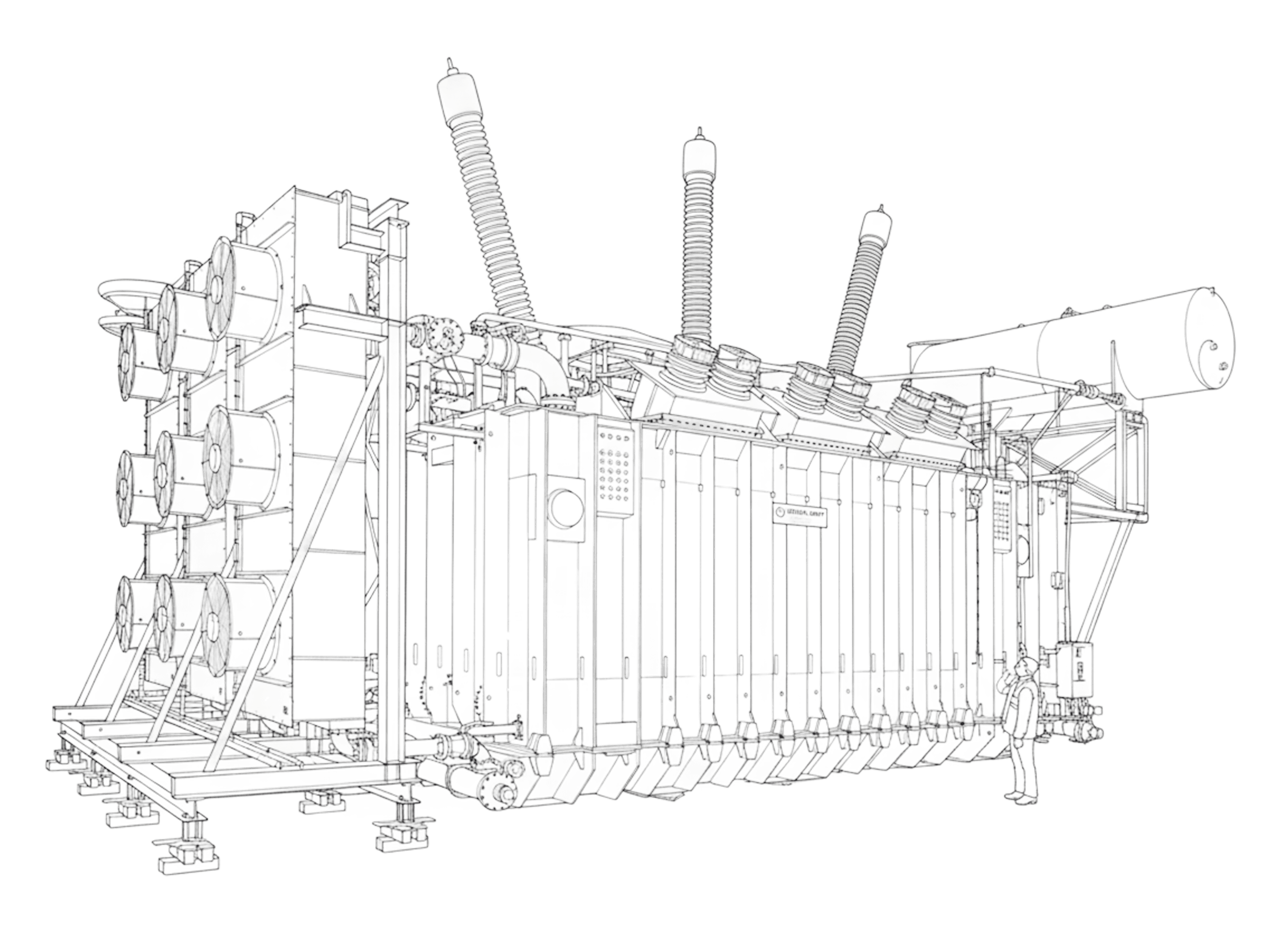
A data centre's electrical bill of materials is long: switchgear, generators, UPS systems, cabling and dozens of smaller transformers inside the halls. One line on it can make or break the energisation date. Our project connects at 132 kV and needs three grid transformers to step that down to 33 kV, sized so that any two can carry the whole site. They're among the longest-lead items on the list, and they're the ones this chapter follows.
On the closest published figures, each costs around £1m, or about £3.1m for the three.* That's a long way short of the £61.75m fee, and a small fraction of the £1.2bn or so that Ofgem's average capital cost implies for a project our size.
Rank everything on a data centre's bill by price and the transformers land comfortably mid-table. Rank it by what can move the energisation date and they go straight to the top.
When we asked our panel of twenty manufacturers to quote, we asked about commercial terms as well as lead times. Eight told us their payment terms. All eight require 90 to 100% of the contract value before the unit reaches site. Four require 100% before it ships (Opna supplier panel, 2026). For our project, that's £2.8m to £3.1m paid for the three grid transformers before any of them reaches site.
The route between signing and shipping varies by factory. The destination doesn't: by the time the transformer leaves the factory, it's paid for, or very nearly.
The factory's logic is sound. A large power transformer is built for one site, to one set of drawings. Once the core steel is cut and the copper is wound, the manufacturer is holding a unit that fits nobody else, and it wants to be paid before that unit leaves the yard. With a full order book, it can ask.
The consequence for the developer is a mismatch of timetables. The factory's billing cycle sets when the equipment money goes out. The lenders' draw schedule sets when money comes in. They're written by different people for different reasons, and nothing obliges them to agree.
Then there's the yard. If the transformer is ready before the site is, it has to wait somewhere, and the suppliers on our panel charge for storage. A unit that's built, paid for and waiting costs money every month it waits.
Ofgem priced the wait.
Ofgem did something regulators don't always do: it built a model and published the results.
Its case study takes a hypothetical 100 MW data centre (close enough to ours in size to be useful) with an unlevered pre-tax return of 14.7% before any fee. It assumes the fee goes in as cash at the end of 2026, then asks what happens to that return for connections in 2029, 2032 and 2035, at fees of 2.5% and 7.5% (case study, pp.28 to 29).
The smallest hit is 20 basis points, for a 2029 connection at 2.5%. The largest is 170 basis points, for a 2035 connection at 7.5% (para 4.18). In between, by our reading of Ofgem's table, a 2032 connection at 7.5% loses about 110. Ofgem reports returns to one decimal place, so the figures we've derived are accurate to about 10 basis points. Our project, with a 5% fee and a 2030 connection, sits between those scenarios, so its hit falls somewhere between 20 and 110 basis points. Ofgem didn't model it, and we won't pretend to be more precision than that.
Ofgem names the cause in one line: "the negative cost of carry until the fee is returned at project energisation." In plainer English, the money is locked up earning less than it costs, and the longer the wait, the bigger the bill.
One subtlety needs stating precisely. Ofgem's variable is the connection date, not the lead time. The model never asks how long a transformer takes to build. It asks how long until the fee comes back. For a project whose energisation date is set by when its equipment arrives, those turn out to be the same question.
Our own arithmetic puts the carry in pounds, using Ofgem's inputs. Our £61.75m, held in cash at Ofgem's 10.95% cost of capital, gives up about £6.8m a year, less whatever interest the deposit earns. That's around £560,000 a month, or roughly £18,500 for every day the site isn't switched on. Across Ofgem's full range, the same calculation runs from about £3.4m a year at 2.5% to £10.1m at 7.5%.
Ofgem concludes that its range "would not materially impact viable projects" (para 4.18). On the fee alone, that's a fair reading: 170 basis points off a 14.7% return. Ofgem's model fixes the connection date in each scenario, which is the right way to isolate the effect of the fee. The next section lets the date move.

What six months cost.
Take the ordinary setback from Chapter 1: six months lost in planning or design. Nobody has done anything wrong, and the developer did what Ofgem proposes and committed to equipment early. This time we follow the delay through the capital stack.
The fee stays out longer. Six more months of carry on our £61.75m: about £3.4m if it's held in cash, or six more months of charges on a bond or letter of credit.
The equipment is already paid for. If the grid transformers were built to the original date, 90 to 100% of their price has gone out (£2.8m to £3.1m on our three units), and they now wait for a site that isn't ready. The storage charges start.
Restructuring costs money. If the order has to move to a later slot or a revised design, the cancellation ladder applies at whichever rung the unit has reached. Once the long-lead parts are committed, the suppliers on our panel put that at most of the contract value.
The financing gets reopened. Project finance usually fixes a date by which construction should be complete, and the lenders' model is built around it. A slip that threatens that date generally means asking lenders to amend or waive, which rarely comes free. A development bridge may need extending too, on whatever terms the market offers that month.
The auditors ask a question. Spend capitalised on an asset that isn't yet in use gets tested for impairment when there's reason to doubt it will earn back its cost. A moved energisation date is the kind of event that prompts the test. The project may pass it comfortably. Someone still has to show why.
The queue position comes into play. If the original order is cancelled, the evidence lodged for M2.Dc may no longer satisfy the milestone. Under the draft code, the developer would have 20 business days to say so and six months to replace it, or the project is categorised for termination (draft CUSC paras 16.4.9.1A.1 and 16.4.9.2). Termination is the event that forfeits the commitment fee: all £61.75m of it.
Item 6 changes the nature of item 1. The £61.75m started life as security, money the developer expected back. At the far end of that chain, it becomes a loss.
Texas has written the same consequence into its rule. Miss the scheduled energisation date by more than 24 months and the security goes towards what the utility is owed.
You'd hope all of this adds up to a published number. As far as we can find, it doesn't. Developers know their own figure and, understandably, keep it to themselves.
Ofgem's table offers a sense of scale, in a column it doesn't discuss. With no fee at all, the same hypothetical project is worth £210m if it connects in 2029 and £163m if it connects in 2032, both measured from the end of 2026 (case study, p.28). Ofgem doesn't explain the gap. Our reading is that later cash flows are discounted more heavily. That's three years rather than six months, and a model rather than a project, so treat it as an indication of scale and nothing firmer.
For our project, the one line we can price from public numbers is the fee carry: about £3.4m for six months. That's slightly more than the £3.1m the three grid transformers cost to buy. At around £560,000 a month, the carry overtakes their price after about five and a half months. The stranded equipment, the refinancing and the queue risk sit on top of that, and the full total for a real project isn't public. If you've run that number for your own project, we'd like to compare notes.

The blue line is our project at a 5% fee. The shaded band is the same calculation across Ofgem's full range, and even at 2.5% the carry overtakes the transformers in under a year.
When capital follows the project.
Two things change when equipment money tracks the project's draw schedule instead of the factory's billing cycle.
The first is timing. Capital goes out as the project reaches the milestones its lenders fund against. If the date moves, the payments move with it, and nothing sits paid for and stranded months ahead of a site that isn't ready.
The second is the risk register. When the slot is confirmed, the supplier verified and the payment profile known before FID, lenders and investment committees see a settled equipment position on the day they decide.
Neither stops a project slipping. Both limit how far one slip spreads through the capital stack. That's the part of the problem Opna works on.
Two bills, one date.
Our project carries £61.75m of security and most of its equipment bill before it earns a pound. Both calls on capital share a weakness. They're pinned to an energisation date that's set somewhere else: in a factory's calendar, a planning office, a regulator's milestone table. When that date moves, the money doesn't move with it.
If you'd like to see your own capital profile laid against your energisation date, talk to us.
Bring the date. We'll bring the payment terms.
Keep reading:
Build the market, not just the factories: Opna's market infrastructure blueprint for the critical power supply chain.
* How we priced the grid transformers. These figures are indicative only, not quotes. They come from ACER, the EU agency for energy regulators, and its "Energy infrastructure unit investment cost indicators", published on 24 April 2026 (Table I.3). ACER doesn't publish a 132/33 kV class, so we used the nearest class it does publish, 150/50 kV: a median of €1.23m per transformer across five units, with a range of €1.14m to €2.06m. We converted these to pounds at the European Central Bank's euro reference rate for 3 November 2026 (€1 = £0.83358), which gives a median of about £1.03m and a range of about £0.95m to £1.72m, then multiplied the median by three. Exchange rates move, so the sterling figures will drift. Network operators submitted ACER's data between October 2025 and January 2026, and it includes projects from ACER's 2023 edition. ACER adjusts for inflation but doesn't state the price year, the rating of each unit, or whether installation is included. Many of these prices will reflect orders placed before the latest surge in demand: the IEA reported in February 2025 that power transformer prices had risen by around 75% since 2019 ("Building the Future Transmission Grid"). With demand still rising, a transformer ordered today could cost more than these figures suggest. The three-unit, 132/33 kV configuration is our own illustrative assumption for a site with 100 MW of IT load and a 130 MW grid connection.
Sources.
Ofgem, "Consultation Curate: Demand Connections Reform", 29 July 2026: executive summary (return and forfeiture), paras 3.1 and 5.1 (fee held from offer acceptance to energisation), paras 4.1 and 4.14 (fee range and calibration), para 4.15 (international comparators), para 4.18 and case study pp.28 to 29 (IRR and NPV impact, cost of carry, cash as worst case), para 5.26 (forms of security), para 5.27 (forfeited securities).
Ofgem, draft CUSC legal text published with the Curate consultation, 29 July 2026: paras 16.4.9.1A.1 and 16.4.9.2 (replacement obligation and termination).
Climate Neutral Data Centre Pact, "Initiative for Climate Neutral Data Centres in Europe": annual PUE target of 1.3 for new data centres in cool climates.
ENTSO-E, "Data centres and the power system: expected trends, challenges, and opportunities", April 2026: section 4.2 (capacity allocation, financial guarantees and deposits).
Latham & Watkins, "New Grid Access Rules in Spain: Key Takeaways", 11 May 2026, summarising Royal Decree-Law 7/2026.
White & Case, "PUCT sets financial commitments for data center interconnection as governor pauses permit approvals", 25 September 2026, summarising Public Utility Commission of Texas Project No. 58481 (16 TAC § 25.194).
ACER, "Energy infrastructure unit investment cost (UIC) indicators", 24 April 2026: Table I.3, p.45 (transformer cost per asset, 150/50 kV class); slides 5, 8 and 9 (data collection period and inflation adjustment).
European Central Bank, euro foreign exchange reference rates, 3 November 2026: €1 = £0.83358.
IEA, "Building the Future Transmission Grid", February 2025, as reported by TD World, 27 February 2025: power transformer prices up around 75% since 2019.
Opna supplier panel, 2026: twenty manufacturers; eight disclosed payment terms. Storage charges and cancellation terms. Proprietary, published in aggregate only.
Opna, "You ordered your transformer too late. You just haven't found out yet.", The Choreography Crisis, November 2026.
Opna, "Your energisation date is set in a factory, not a queue", The Choreography Crisis.